Every Dog Has Something To Teach Us.
Understanding one kind of dog is not the same as understanding dogs. A family companion, a wild canid, a livestock guardian, a detection dog, a newborn puppy and a service dog each answer a different question… and none of them can answer all of them alone.
“Why we studied everything… because the dog is everything at once.”
Why We Never Wanted Only One Perspective
Brain First Development™ did not begin with a method. It began with a question that would not go away… why do knowledgeable people who all clearly love dogs so often describe the same dog in completely different ways?
A veterinarian sees a body. A breeder sees a bloodline and a first week of life. A behaviorist sees a pattern of learning. A wildlife biologist sees ancient inheritance. A nutritionist sees the fuel that built the brain. A service dog handler sees emotional regulation under pressure. A family sees the dog who sleeps by the door every night for twelve years.
Every one of those views is accurate. Not one of them is complete. So instead of choosing a discipline and defending it, Brain First chose to keep asking all of them… and to keep asking long enough for the answers to start agreeing.
That is what "we studied everything" actually means. It is not a claim of expertise in every field. It is a refusal to accept a partial answer about a whole animal.
Fields of study consulted continually… from wild canid research to family life
Years of collaborative observation across disciplines
Recommendations refined whenever new, credible evidence appears
No single discipline holds the whole dog… each one holds a corner of the same truth.
Learning From Every Corner of the Canine World
Each field below answered a question the others could not. Open any card to read what that corner of the canine world contributes to understanding canine behavior and development.
Wolves and Wild Canids
Instinct • Communication • SurvivalWild canids show us what dogs are before people shape them. Family structure, cooperative raising of young, subtle body language, resource behavior and survival decision making all appear here in their original form.
Wolves and Wild Canids
Wild canids show us what dogs are before people shape them. Family structure, cooperative raising of young, subtle body language, resource behavior and survival decision making all appear here in their original form.
Studying wild canids does not mean treating dogs as wolves. It means recognizing which behaviors are ancient and purposeful rather than accidental or disobedient. When a puppy freezes at a strange sound, guards a novel object or watches a group before joining it, we are seeing inheritance… not defiance. That distinction changes every recommendation we make.
Responsible Breeders
Genetics • Temperament • Early DevelopmentBreeders observe the earliest hours of life… genetics, maternal behavior, litter dynamics, neonatal handling and the first sensitive periods that shape a lifetime.
Responsible Breeders
Breeders observe the earliest hours of life… genetics, maternal behavior, litter dynamics, neonatal handling and the first sensitive periods that shape a lifetime.
A thoughtful breeder watches temperament emerge before a puppy has learned to cope with anything. They see how a mother regulates her litter, how littermates negotiate, how a puppy recovers from a startle at three weeks. This is developmental information that simply cannot be recovered later, and it is one of the reasons Brain First assessments begin so early.
Companion Dogs
Relationship • Attachment • Daily LifeFamily dogs teach us about attachment, trust, routine, household stress and what it actually means for a dog to live inside human life.
Companion Dogs
Family dogs teach us about attachment, trust, routine, household stress and what it actually means for a dog to live inside human life.
Companion dogs live in the most complicated environment we ask any animal to navigate… doorbells, schedules, visitors, children, elevators, moving vans and emotional weather. Understanding attachment, secure base behavior and recovery inside a real home is central to understanding dogs as they actually live.
Sporting Dogs
Purpose • Motivation • Natural AbilitySporting dogs reveal inherited purpose… how selective breeding shapes motivation, stamina, style and the deep satisfaction of doing the work a body was built for.
Sporting Dogs
Sporting dogs reveal inherited purpose… how selective breeding shapes motivation, stamina, style and the deep satisfaction of doing the work a body was built for.
Watching a retriever mark a fall or a terrier work a hedge shows how much of behavior is simply purpose looking for an outlet. Many household frustrations are inherited motivation with nowhere to go. Recognizing that pattern turns a behavior problem into a development question.
Livestock Guardians
Independence • Confidence • JudgmentGuardian dogs demonstrate independent thinking, patience, threat assessment and confident decision making without a handler present.
Livestock Guardians
Guardian dogs demonstrate independent thinking, patience, threat assessment and confident decision making without a handler present.
Guardians are asked to evaluate a situation and choose a response entirely on their own, often at night, often alone. They show us that confidence is not obedience and that good judgment is developed rather than commanded… a lesson that applies directly to family dogs facing unfamiliar situations.
Detection, Military and Police Dogs
Resilience • Focus • Problem SolvingWorking dogs show what resilience and environmental confidence really look like… sustained focus, recovery under pressure and creative problem solving.
Detection, Military and Police Dogs
Working dogs show what resilience and environmental confidence really look like… sustained focus, recovery under pressure and creative problem solving.
These programs have studied stress, recovery, arousal management and environmental exposure more carefully than almost any other field, because the cost of getting it wrong is enormous. Their findings on gradual exposure, recovery time and confidence building translate remarkably well to ordinary family life.
Therapy, Service, ESA and Facility Dogs
Regulation • Connection • AdaptabilityThese dogs teach emotional regulation, human attunement, adaptability and the capacity to stay settled in unpredictable public environments.
Therapy, Service, ESA and Facility Dogs
These dogs teach emotional regulation, human attunement, adaptability and the capacity to stay settled in unpredictable public environments.
Service dog development in particular has taught us how much of success depends on temperament and emotional regulation rather than on task training. A dog who can recover quickly, read a person accurately and remain neutral in chaos is showing developmental capability… not a trained trick.
Veterinary Medicine
Health • Growth • Medical InfluenceVeterinary teams reveal how pain, illness, hormones, structure and neurological health quietly shape behavior long before anyone calls it a behavior problem.
Veterinary Medicine
Veterinary teams reveal how pain, illness, hormones, structure and neurological health quietly shape behavior long before anyone calls it a behavior problem.
Sudden reactivity, new guarding, reluctance on stairs, shortened patience… all of these can be medical before they are behavioral. Working alongside veterinary professionals keeps us honest, and it is why Brain First always asks about health and comfort before assuming a behavior is learned.
Nutrition
Brain Growth • Physical Health • LongevityNutrition connects brain development, growth rate, gut health, inflammation and lifelong wellbeing… the brain is built from what the body receives.
Nutrition
Nutrition connects brain development, growth rate, gut health, inflammation and lifelong wellbeing… the brain is built from what the body receives.
Nutrient availability during early growth influences how a nervous system matures. Growth rate influences joints and comfort. Gut health influences inflammation and mood. None of this replaces development work, but nutrition is developmental input, not an afterthought.
Universities and Research Organizations
Evidence • Testing • RefinementAcademic research continually tests, corrects and refines what we believe about canine cognition, emotion, genetics and development.
Universities and Research Organizations
Academic research continually tests, corrects and refines what we believe about canine cognition, emotion, genetics and development.
Peer-reviewed research keeps observation honest. It tells us when a comfortable belief does not survive careful testing, and it regularly improves on what the field accepted a decade ago. Brain First treats research as a correction mechanism, not a marketing badge.
Families Became Some of Our Greatest Teachers
It would be easy to build a philosophy entirely out of professionals. It would also be wrong. Families see something no researcher, veterinarian or trainer ever sees… the whole ordinary life of one dog, every single day, for years.
A professional may meet a dog for an hour. A family lives with that same dog through teething, adolescence, a move across town, a new baby, a frightening storm, an illness and a slow, dignified old age. They watch confidence appear. They watch recovery get faster. They notice the day the flinch stopped.
Brain First treats family observation as real developmental evidence. When a family says "he is fine everywhere except the kitchen after dinner," that is not an anecdote… that is data, and it has corrected our thinking more than once.
Time no professional has
Families see thousands of ordinary hours… mornings, storms, illnesses, moves, holidays and quiet evenings across many years.
Patterns across a lifetime
They notice the slow changes… the fear that faded, the confidence that grew, the recovery that became faster each season.
Emotional truth
Families describe what a dog feels like to live with, which is often more revealing than what a dog does in a twenty-minute evaluation.
Honest feedback
When advice does not work in a real kitchen with real children, families tell us… and that feedback improves the recommendation for everyone who comes next.
Because families are the ones living the results. A recommendation that works beautifully in a training facility and fails in a real kitchen with three children and a job to get to is not a good recommendation… it is an untested one.
How Do All of These Specialties Influence One Another?
Specialization is how knowledge advances. A veterinary behaviorist, a canine geneticist, a nutritionist and a detection dog trainer each go deeper into their field than any generalist ever could, and dogs are better off for it.
But somewhere between those specialties, a question was going unasked. Not "what does genetics explain," or "what does nutrition explain," or "what does learning explain"… but how do all of them shape one another inside a single living dog?
A genetic tendency toward caution meets an environment with too much novelty. Rapid growth meets joint discomfort meets a shortened tolerance for handling. A missed sensitive period meets a loving family who cannot understand why kindness alone is not enough. None of these live in one column.
Behavior cannot be fully understood by looking at only one part of a dog's life. Everything influences everything else.
- Genetics
- Instinct
- Nutrition
- Environment
- Emotional Development
- Family Dynamics
- Health
- Learning
- Development
A Philosophy Built On Curiosity
Brain First Development™ does not claim to know everything about dogs. Anyone who has spent thirty years watching them knows better than that. What Brain First does claim is a commitment to asking better questions, and to changing our answers when the evidence earns it.
Certainty is comfortable. It is also the fastest way to stop learning. The most valuable moments in three decades of study were not the moments something was confirmed… they were the moments a dog did something that did not fit, and we had to go back and look again.
Canine science is moving quickly. Cognition, emotion, genetics, early neurological development, nutrition and the gut-brain relationship are all better understood today than they were even five years ago. A philosophy worth trusting has to be able to grow with that.
The greatest discoveries begin with the humility to ask better questions.
Lifelong Learning, Collaboration and Continual Improvement
Brain First Development™ will continue refining its recommendations whenever new, credible evidence improves our understanding of canine development. That is a promise, not a disclaimer.
We consider this one of the organization's greatest strengths. A philosophy that cannot change is a monument. A philosophy that keeps learning is a living body of understanding… and dogs deserve the second one.
We follow the evidence
When credible new research improves our understanding, our recommendations change. Consistency with the evidence matters more than consistency with our own past statements.
We keep collaborating
Veterinarians, breeders, behaviorists, researchers, working dog professionals and families all continue to teach us things we could not learn alone.
We keep observing
Observation never stops. Every puppy, every family and every adult dog adds something to what Brain First understands about development.
We stay humble
Certainty closes the door on learning. Curiosity keeps it open… and the dogs are always better served by the open door.
Frequently Asked Questions About Studying the Whole Canine World
Why study wolves if dogs are not wolves?
Because wild canids show behavior that no human has shaped. That gives us a baseline for separating inherited tendencies from learned responses. It is context, not a training model… dogs are their own species with their own long history alongside people.
Why do working dog programs matter to a family with one pet?
Detection, police, military, guardian and sporting programs have studied stress, recovery, focus and environmental confidence more rigorously than almost anyone. Those same capabilities decide how a family dog handles a thunderstorm, a vet visit or a crowded sidewalk.
Isn't it enough to study behavior itself?
Behavior is the last thing to appear. Genetics, health, nutrition, environment, emotion and relationship all arrive first. Studying only behavior means studying the ending without ever reading the story.
Does Brain First Development™ conduct its own research?
Brain First conducts long-term structured observation and works alongside professionals across many disciplines. It relies on peer-reviewed research from universities and research organizations to test, correct and refine what observation suggests.
What happens when new science contradicts something Brain First teaches?
We change. Refining recommendations when credible new evidence appears is not a weakness in the philosophy… it is the philosophy.
Which breeds does Brain First Development™ work with?
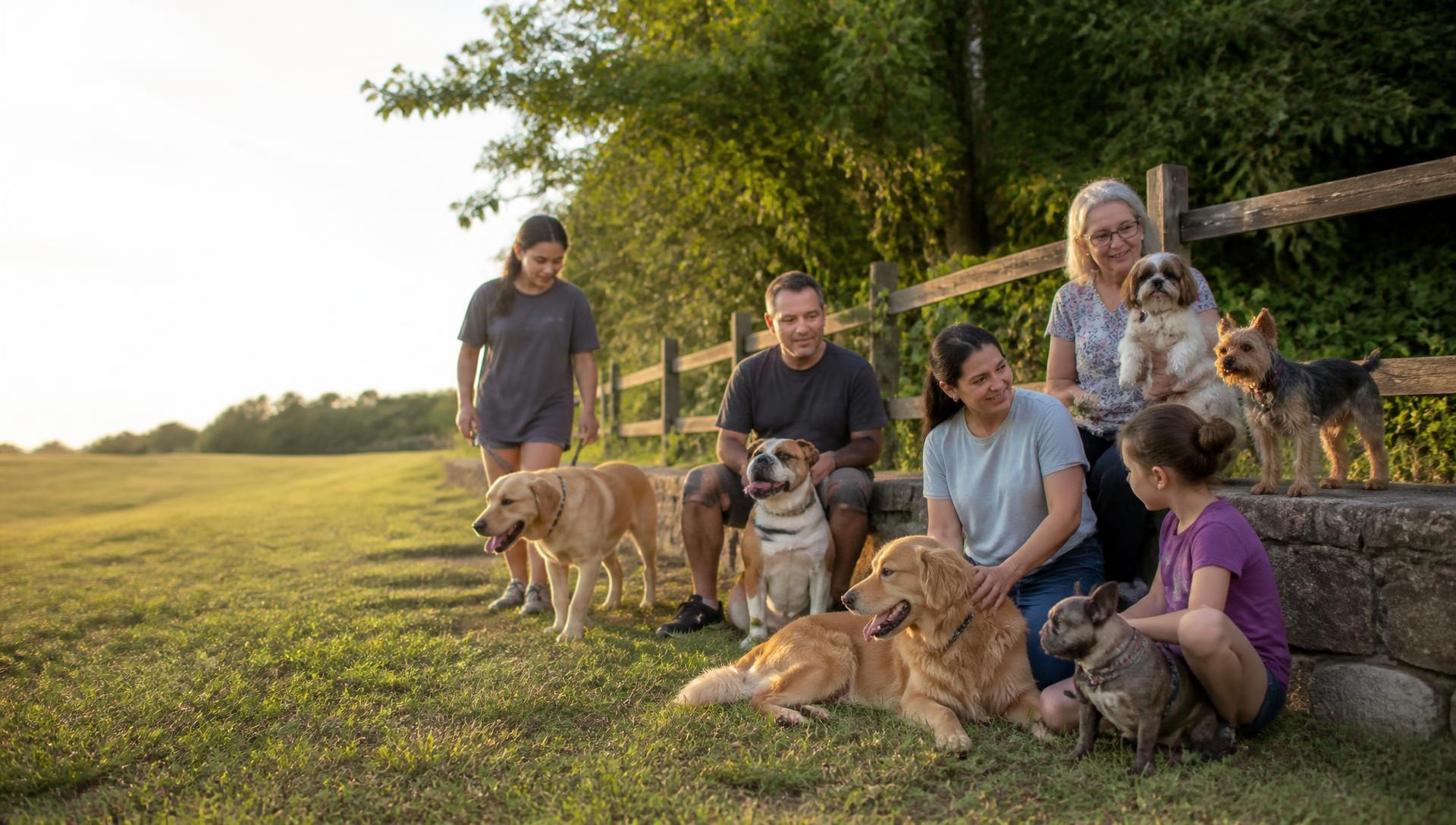
Development applies to every dog. The examples throughout our education pages feature Olde English Bulldogges, Labrador Retrievers, Golden Retrievers, Shih Tzus, Yorkshire Terriers and French Bulldogs, but the developmental principles are universal.
The Science of Development
Studying wolves, breeders, companions, sporting dogs, guardians, working dogs, service dogs, veterinary medicine, nutrition, research and families eventually led to one unavoidable conclusion… healthy development always comes before healthy behavior.
The next chapter looks at what that development actually is… sensitive periods, brain growth, emotional regulation and the quiet architecture built long before anyone thinks to call a trainer.
Continue Through the Brain First™ Educational Series
Questions about canine development, puppy brain development, behavior development, breeding, nutrition, therapy dogs, service dogs or our connected learning pages are always welcome.
“Develop the brain… and behavior follows.”