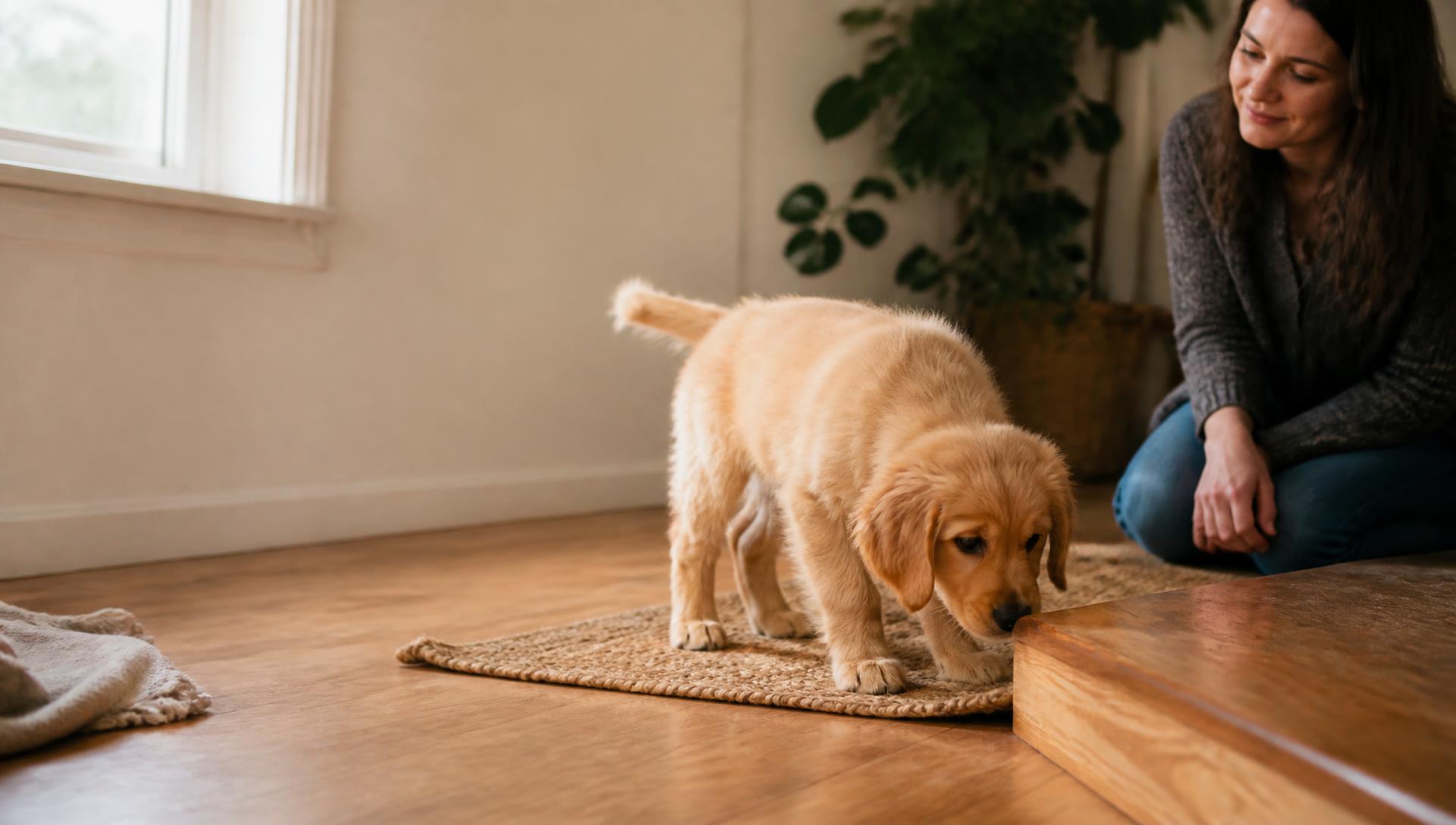
The Brain Is Always Developing.
Every experience a puppy has… every sound, surface, meal, greeting, nap and small surprise… becomes information the developing brain uses to build itself. Nothing a puppy lives through is neutral.
“Develop the brain... and behavior follows.”
Behavior Is the Result... Not the Beginning
Behavior is communication. It is a dog telling us, in the only language available to them, what their body and brain are experiencing right now.
Unwanted behavior is almost never the actual problem. It is the visible tip of something deeper… discomfort, confusion, arousal that has nowhere to go, a missing skill, a nervous system that never learned how to come back down.
So Brain First changes the first question. Instead of asking "how do we stop this behavior," we ask something more useful.
“How do we stop this behavior?”
A reasonable question that often produces a short-term answer… and leaves the underlying development untouched.
“What is the brain trying to accomplish?”
A question that leads to the cause… and to changes that tend to hold, because capability grew rather than being suppressed.
What sits beneath visible behavior
Read this from the top down. Only the first layer is visible to the outside world… everything below it is development, quietly deciding what that visible layer will look like.
Visible Behavior
VisibleThe only layer most people ever see… barking, pulling, freezing, jumping, hiding, guarding, greeting.
Learning History
Everything this dog has already practiced, rehearsed and had confirmed by the world around them.
Relationships
Trust, safety and communication with the people and animals sharing daily life.
Environment
Sound, surface, space, routine, novelty and predictability… all constantly teaching.
Nutrition
The raw material of brain growth, energy regulation, gut health and comfort.
Physical Health
Pain, structure, hormones, vision, hearing and illness quietly shape what a body is willing to do.
Emotional Regulation
How arousal rises, how long it stays high and how completely a dog recovers afterward.
Brain Development
Neurological maturity and timing… what this brain is currently capable of processing.
Instinct
Ancient, purposeful drives that explain far more behavior than most people expect.
Genetics
Inherited thresholds, tendencies, structure and sensitivity… the starting conditions.
Working only at the top of this illustration can change what a dog does. Working through the layers beneath it changes what a dog is able to do... and that is a very different result.
The Developing Brain, From Birth Through Adulthood
Puppies do not simply get bigger. They pass through distinct developmental periods, each one opening opportunities the brain is unusually ready to use… and each one eventually closing.
These periods overlap, vary between individuals and are influenced by genetics, health and environment. The ages below are honest approximations rather than deadlines. Open any stage to read what is actually being built.
- Birth to about 2 weeks
Neonatal Period
Warmth, touch, nourishment and rest… the nervous system's first quiet construction.
Eyes and ears are still closed. The puppy experiences the world almost entirely through touch, smell and temperature. Gentle, brief handling and a calm, well-managed whelping environment support early stress-response development. Nothing here looks like training, and all of it is development.
- About 2 to 3 weeks
Transitional Period
Eyes and ears open… the world arrives all at once.
Sight and hearing come online, first wobbly steps appear and littermates become social partners rather than warm objects. The brain begins connecting sensation to meaning. Small, gentle novelty introduced now becomes ordinary rather than alarming later.
- About 3 to 12 weeks
Socialization Period
The brain is unusually ready to decide what is normal.
This is the period most people have heard about, and for good reason. Puppies form lasting impressions of people, animals, sounds, surfaces and situations with remarkable efficiency. Quality matters far more than quantity… positive, well-paced experiences with genuine recovery build confidence, while overwhelming ones build caution. Brain First observes closely here at four, six, eight and twelve weeks.
- Woven through the socialization and juvenile periods
Fear Impact Windows
Brief stretches where the brain is especially sensitive to frightening experiences.
During these windows, a single startling event can carry more weight than it would at any other time. The response is not to hide a puppy from the world… it is to notice, slow down, allow full recovery and let the puppy re-approach on their own terms. Recovery is the developmental skill being built.
- About 3 to 6 months
Juvenile Period
Coordination, independence and real problem solving appear.
Teething, growing bodies and expanding curiosity all arrive together. Puppies begin testing how the world responds to them. Impulse control is still physically immature, so consistency, structure and rest matter far more than repetition of skills.
- About 6 to 18 months, varying by individual
Adolescence
The reorganizing brain… familiar things suddenly feel new again.
Hormonal change, continued brain maturation and a widening world can make a previously easy dog feel unfamiliar. This is not regression or defiance. It is construction. Families who understand adolescence tend to come through it with the relationship intact.
- About 18 months to 3 years
Social Maturity
Adult patterns settle… and development continues.
Preferences, tolerances and social style stabilize. Some tendencies present since birth become clearer. Development slows but never stops, and continued enrichment, regulation work and relationship keep the brain flexible.
Every developmental stage creates opportunities that cannot always be recreated later with the same ease. That is not a reason for pressure or worry... it is a reason to pay attention while the door is open.
Emotional Development Comes Before Performance
A brain that feels safe can take information in. A brain that feels threatened is busy doing something far more urgent than learning.
This is why emotionally healthy puppies learn more efficiently. It is not that they are smarter or more willing. It is that their nervous system is available. Every skill we eventually want... focus, patience, recall, settling, greeting politely... is built on top of the qualities below.
Curiosity
A curious brain moves toward information. Curiosity is the earliest visible sign that a puppy feels safe enough to learn.
Confidence
Confidence is built through successful small challenges, not through avoiding challenge or forcing exposure.
Recovery After Stress
Every puppy startles. What matters developmentally is how quickly and completely they return to themselves afterward.
Emotional Regulation
The ability to rise in arousal and come back down again… the quiet skill underneath nearly every well-behaved dog.
Resilience
Resilience grows when a puppy experiences manageable difficulty and discovers they can come through it.
Adaptability
Novelty stops being threatening when a brain has learned that new things reliably become familiar things.
Secure Attachment
A trusted person becomes a safe base. From that base, a puppy will explore further and learn faster than fear could ever push them.
A puppy who feels safe is a puppy who can learn. Everything else is built on that.
The Environment Is Always Teaching
There is no such thing as a puppy who is not learning. Training sessions are a tiny fraction of a puppy's day... the other twenty-three hours are teaching too.
Homes teach. Routines teach. Sounds, smells, floor surfaces, stairs, doorways, schedules, meals, sleep, visitors, children and the emotional weather of the household all teach. A predictable morning teaches regulation. A chaotic evening teaches vigilance. Neither one requires anyone to intend it.
Development never occurs in isolation. Change one part of a puppy's world and the other parts shift with it... which is why Brain First looks at the whole system rather than a single behavior.
- Home & Space
- Routine
- People
- Sound
- Smell
- Surfaces
- Nutrition
- Rest & Sleep
- Daily Experience
Development Cannot Be Rushed
Development follows biology, not calendars. A nervous system matures at the pace it matures, and no amount of enthusiasm, repetition or good intention moves that timeline forward.
This is genuinely good news. It means families are not behind, and it means a slower puppy is not a failing puppy. It means the most valuable thing we can offer a developing brain is time... time with support, structure, rest and safety around it.
Along the way, the brain opens certain windows when it is especially ready for certain kinds of learning. Those windows are real, they are worth understanding, and one of them turned out to matter far more than we expected. That is where the next chapter begins.
Biology sets the pace
Maturity arrives when the body is ready, not when the schedule says it should.
Rest is development
Sleep is when experience is consolidated. A tired puppy is not learning… a rested one is.
Windows, not deadlines
Certain periods make certain learning unusually easy. Missing one is a detour, never a dead end.
Brain First Development™ In Practice
None of this stays theoretical. Below are ordinary situations every family meets, and the developmental reasoning behind how Brain First approaches them. This is not a judgment of other approaches... many of them work. It is simply a look at what changes when development leads.
Fear
A common responseReassure quickly, then ask the dog to keep going.
Brain First approachCreate distance, allow full recovery, then let the dog re-approach by choice… so the nervous system learns that recovery is possible.
Fear
Reassure quickly, then ask the dog to keep going.
Create distance, allow full recovery, then let the dog re-approach by choice… so the nervous system learns that recovery is possible.
Fear is a nervous system state, not a decision. A brain in that state is not available for learning. Restoring regulation first is what makes the next experience useful rather than confirming.
Excitement
A common responseWait for the excitement to pass, then continue.
Brain First approachBuild predictable rise-and-settle patterns into ordinary life so arousal has a practiced route back down.
Excitement
Wait for the excitement to pass, then continue.
Build predictable rise-and-settle patterns into ordinary life so arousal has a practiced route back down.
Excitement and stress share much of the same physiology. A dog who practices coming down from high arousal in happy moments has that skill available in hard ones.
Overstimulation
A common responseAdd more exposure so the dog gets used to it.
Brain First approachReduce the input, protect sleep and rest, then reintroduce gradually with room to recover.
Overstimulation
Add more exposure so the dog gets used to it.
Reduce the input, protect sleep and rest, then reintroduce gradually with room to recover.
An overloaded brain does not habituate… it sensitizes. Rest is not a pause in development. Rest is when development consolidates.
Frustration
A common responseInterpret it as stubbornness or testing boundaries.
Brain First approachTreat it as a mismatch between the task and current capability, then adjust the difficulty so success is reachable.
Frustration
Interpret it as stubbornness or testing boundaries.
Treat it as a mismatch between the task and current capability, then adjust the difficulty so success is reachable.
Frustration tolerance is developed in small doses. Too little teaches fragility, too much teaches shutdown. The middle is where capability grows.
Environmental Change
A common responseExpect the dog to adjust within a few days.
Brain First approachRebuild predictability first… same rest places, same routines, same people, then slowly widen the world again.
Environmental Change
Expect the dog to adjust within a few days.
Rebuild predictability first… same rest places, same routines, same people, then slowly widen the world again.
A move, a new baby, a renovation or a schedule change removes the predictability a dog was using to regulate. Restoring that foundation restores behavior far faster than addressing the behavior directly.
A Lifetime of Development
Development never truly stops. The brain remains capable of change through adolescence, adulthood and into the senior years, which means understanding, confidence and regulation can keep growing for as long as a dog is with us.
That is why Brain First supports dogs and families across every stage of life rather than only through puppyhood. The questions change as a dog ages... the developmental thinking does not.
Puppyhood
Foundations of curiosity, recovery and trust… the developmental work that everything else will rest on.
Adolescence
Reorganization and testing. Support and consistency matter more here than any new skill.
Adulthood
Refinement, partnership and deepening communication as capability and relationship mature together.
Senior Years
Comfort, cognitive enrichment and dignity. Older brains keep learning when they are kept engaged and comfortable.
Healthy behavior grows from healthy development.
Frequently Asked Questions About Canine Development
If behavior is only a symptom, does training still matter?
Absolutely. Skills matter, and they are far easier to build and far more durable once development supports them. Brain First simply asks what the brain is currently capable of before deciding what to teach.
My puppy is already twelve weeks old. Have I missed something?
No. Earlier support is easier, but the brain keeps developing for a long time. Development with an older puppy or an adult dog begins in exactly the same place… understanding first, then support, then skills.
Is adolescence really a developmental stage or just bad behavior?
It is genuinely developmental. Hormonal change and continued brain maturation reorganize how a dog processes the world. Recognizing that changes how families respond, and how the relationship survives it.
Why does Brain First talk so much about rest and sleep?
Because consolidation happens during rest. Puppies need a great deal of sleep, and much of what they experienced during the day is quietly built into the brain while they are sleeping.
Does this mean I should protect my puppy from everything difficult?
No. Manageable difficulty is how resilience develops. The goal is difficulty a puppy can recover from, not the absence of challenge and not exposure without recovery.
Is this approach only for professional or working dogs?
Not at all. The same developmental foundation supports family companions, therapy dogs, emotional support dogs, facility dogs and service dog candidates. The expectations differ… the development does not.
Why 16 Weeks?
After decades of collaborative observation, research and practical experience, one developmental period consistently proved too important to overlook. It appeared again and again... in whelping rooms, in family homes, in service dog programs and in the research literature.
The next chapter explains why Brain First Development™ asks future working dogs to remain in development until at least sixteen weeks of age, and what that additional time makes possible for every dog.
Behavior Is Where Development Becomes Visible
Questions about puppy brain development, developmental stages, emotional regulation, behavior development or our connected learning pages are always welcome.
“Develop the brain... and behavior follows.”